You know what hasn't really changed in a hundred years? How we search our inventory. Either on paper or a computer, when you want to find something, you must search for the exact terms and category to get the correct results. Miss any little detail, and the item might as well not exist, even if it's right there on the list.
Every failed search means someone abandons their spreadsheet and makes needless phone calls, turns boxes inside out, or painstakingly searches rows of shelves to find what they're looking for. The frustration also shows up in the numbers. "Phantom" items that exist but can't be found lead to duplicate purchases and rushed shipping for "replacements".
But the good news is, we're finally watching this model collapse. The new wave of Agentic Artificial Intelligence moves us from searching databases to having conversations with them. With Scanlily's Ask Anything feature, you don't search your inventory anymore. You just ask it questions.
Why Traditional Inventory Search Falls Short
On traditional databases, an item either belongs in a category or it doesn't. If someone accidentally files a laptop under "Office Supplies" instead of "IT Assets," filters miss it completely. AI is not binary; it instead uses judgment calls.
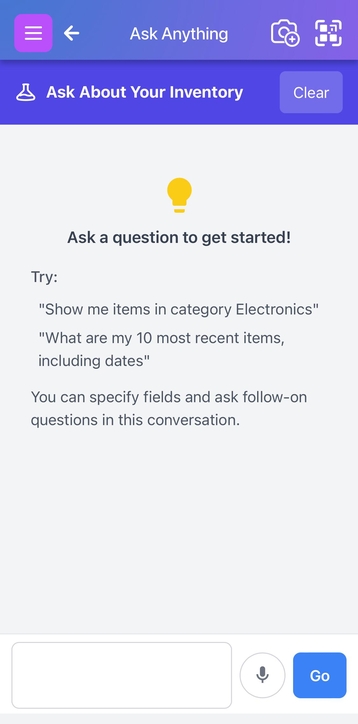
Unlike a passive search bar that matches text strings, an agentic tool works like a knowledgeable assistant, bridging the gap between the unstructured way humans think (context, description, history) and the structured way computers store data.
Scanlily's Ask Anything tool allows you to query your inventory using both text and voice search for the most convenience.
So, how does the AI actually understand your questions?
Introducing Conversational Inventory Search
Ask for "electronic items," and the system will decide: Does a USB speaker count? Obviously. What about a battery? Technically, it's chemical storage, but functionally electronic. A smart thermostat? An electric toothbrush? Factual questions like item count and location give the same answer every time, while descriptive queries are flexible. Scanlily's Ask AI uses this flexibility to broaden search and catch miscategorized items.
For example, traditional inventory systems can't help when you generically ask, "Where's the Nikon camera I bought last week and please give me the specs?" Our Ask AI feature, however, can use Natural Language Processing (NLP) and training data to analyze what you said and cross-reference item logs, location history, and time stamps to return a specific answer. A process that could take anywhere from 10 or more minutes searching for inventory is now done in seconds!
Your inventory system is now an active partner in operations, and not only a data library. What's more fascinating is, again, unlike traditional systems, you don't need any special skills to use it. It's almost as easy as opening your search engine, where you can either use text or voice search.
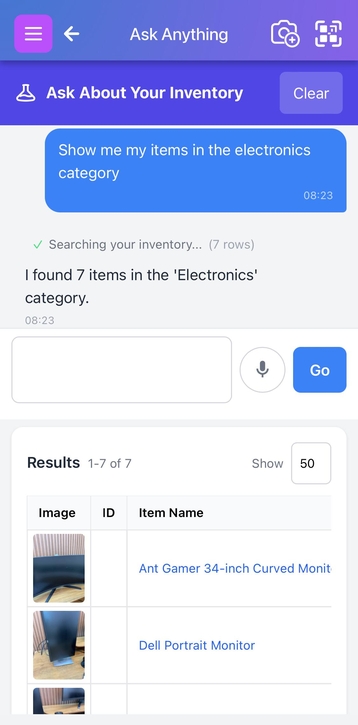
The search results appear as a list you can click or export in PDF or CSV format. Your entire staff can access insights and generate these reports without training, changing the speed at which your business can operate. The Ask AI feature also works in multiple languages, which is great for global supply chains and workforces.
Scanlily's Ask AI Use Case Examples in the Real World
The true test of any technology is its application to real-world problems. By mapping the needs of different vertical markets, we see how the Ask AI feature uses the information bank you build with our other features to address pain points that traditional software cannot.
Construction Sites
Construction sites can be disorganized, with expensive assets spread in different trucks and warehouses, sometimes across regions. Without visibility, site managers hoard equipment or rent duplicates because they can't locate owned units. Finding one tool among thousands becomes nearly impossible when you don't know where to look.
The old way: Filter by location, run a report, export to a spreadsheet.
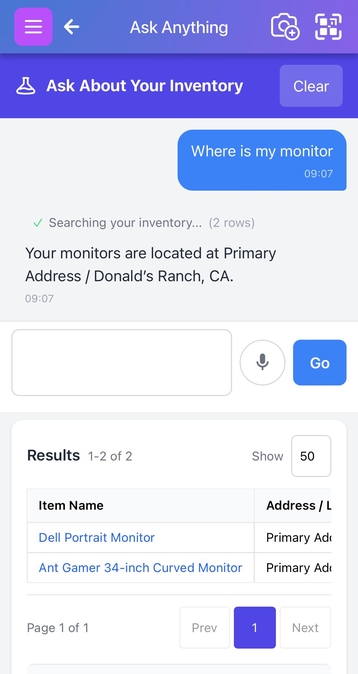
The Scanlily way: Using Ask AI, a site manager can ask: "What equipment is currently at the Riverside project?" The system uses GPS data mapped to items and returns location-based inventory. A worker who finds an unfamiliar tool can describe it, and the search matches the visual description to inventory records. Even for maintenance, safety officers can ask "Which harnesses haven't been inspected in 6 months?" and instantly generate a checklist. The possibilities are limitless!
Works with: Scanlily GPS Tracking and Reminders.
Media, Broadcasting, and Events
Production runs on impossible deadlines. Camera kits, lighting equipment, and audio gear are constantly checked out for shoots. If one item is lost in a kit, the whole set may become unusable.
The old way: Search exact item name, scroll through results, open multiple records, ask everyone.
The Scanlily way: You can ask, "Where's the camera kit we used in San Diego last week?" and get your answer in seconds.
Another problem is the schedules. Two producers may need the same camera on the same date, and there's no way to check availability in real time. You can ask "Is the RED Komodo available for next Friday?" and get yes/no answers. After a shoot, camera assistants speak into the app: "Mark the Sony A7s as 'Sensor Cleaning Needed.'" Later, if a tech manager asks "Show me all cameras needing maintenance," they get the lists.
Works with: Scanlily Equipment Booking System and Web Calendar.
IT Asset Management
Large IT departments use thousands of identical laptops and monitors assigned to hundreds of employees. Here, knowing who has an item likely matters more than knowing where it is. Even tracking things like warranty expirations creates data overload.
The old way: Look through tens of pages of spreadsheets.
The Scanlily way: IT admin asks "List all assets assigned to the Marketing Department," or "Show me all laptops purchased in 2022," and gets an instant report for restocking or replacements. You can even ask, "What's the total value of assets in the Server Room?" to calculate insurance reporting.
Works with: Scanlily Audit Trail and Alerts & Flags.
Laboratories
Labs operate under strict health and environmental regulations. Every piece of equipment needs tracking, calibration, and logging. Labs also share expensive instruments, which may also create an availability problem.
The old way: Using paper logs or traditional software to track usage.
The Scanlily way: Lab managers ask, "Show me the calibration history for Pipette set B," and generate audit trails instantly. They can also ask, "Is the Centrifuge available right now?" or "Where is the portable pH meter?" without needing to search labs. Another question, "How many bottles of Reagent X do we have?" prevents delayed experiments.
Works with: Scanlily Shareable Inventory and Transfer Baskets.
Moving and Organizing
Moving can be emotional, especially when you're helping seniors downsize and move their lifetimes of possessions. There might be important family heirlooms packed in the boxes, which should be handled carefully.
The old way: Open every box to find a specific item and items get lost on the way.
The Scanlily way: If you're a mover and you've properly tagged the boxes and items, you can ask, "Which box contains the photo albums?" or "Where is the blue vase?" You can also ask "Show me all items marked for Donation" and automatically create pickup lists. Also, "What's the total value of items going to storage?" assists with insurance for the moving truck.
Works with: Scanlily's Manage Clients, Reports, and Public Message (for lost items).
Getting the Most Value from Scanlily's Ask Anything
Using Scanlily is intuitive, but you also need to frame your questions strategically to maximize its value.
Be Specific
Instead of "Where is the set of flasks?" (which might return 50 results), ask "Where is the set of round-bottom flasks?" or "Where is the set of round-bottom flasks we bought last month?" Specificity helps the NLP engine apply correct filters.
Understand the Difference Between Facts and Descriptions
For audits and financial counts, use direct quantitative language: "How many X do I have?" For finding lost items or browsing, use descriptive language: "Show me anything that looks like a cable." Understand that Scanlily's AI makes judgment calls and might include or exclude items based on how closely they match your description.
Treat it Like a Conversation
If the first answer isn't perfect, don't start over. Refine: "Show me tools." (Gets 500 tools.) and follow up with the question: "Only the electric ones." (Gets 50 tools.) or: "The ones in the truck." (Gets 5 tools.)
Use it for Reporting
Creating reports with legacy systems requires training. You need to know which tables to query and how to join them. Scanlily's Ask AI automatically generates the summary table.
Management should encourage staff to generate their own summaries. Asking: "Show me all the items used on the San Diego project" or "Show me all assets with a value over $500" and then emailing the results reduces the burden on staff and empowers them to manage their own data. Scanlily free users get 10 report downloads or emails before needing to upgrade.
What Comes Next?
As artificial intelligence continues to shape the world around us, global supply chains and inventory management will also be affected. Today, many organizations, big and small, still rely on tribal knowledge. That one warehouse manager who remembers where everything is, or the few supervisors and specialists trained to handle inventory with legacy software.
But this system is not sustainable because a., people retire, and b., spending a lot of money on inefficient software is unreasonable. AI search digitizes this tribal knowledge and makes it accessible. And this is only the beginning. The next phase is already here with predictive and independent search. "You're running low on X. Should I order more?"
Also, by analyzing historical patterns like 'always uses Camera Kit A for the XYZ events', the AI could proactively suggest kitting or maintenance schedules before you even ask. If you're in retail or another client-facing business, AI inventory search directly reduces churn and improves customer satisfaction. If an employee can instantly answer a customer's "Do you have this in blue in the back?" by speaking into their headset, they save the sale.
Final Thoughts
For decades, we've forced humans to speak the language of computers, to think in rows, columns, and keywords. Artificial Intelligence finally helps computers to understand human language. The competitive advantage now belongs to organizations that stop searching their inventory and start talking to it.
With Scanlily's Ask AI, a foreman or stagehand can access the same data depth as a business analyst. The only difference between your new and improved inventory and a search engine is that you get to build yours, without breaking your brain or bank account.